
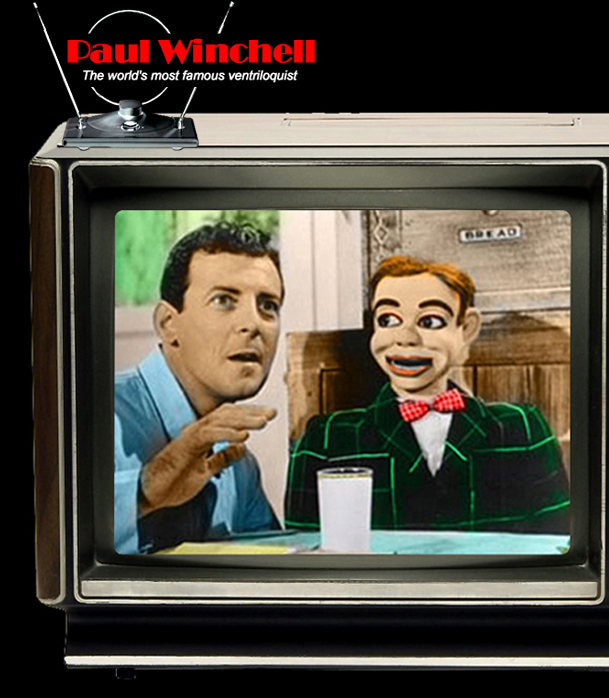

December 21, 1922 - June 24, 2005
Paul Winchell had a lifetime of achievements however
I was most impressed with what he was doing right up
until
his passing. At 82 Paul was still active and was working
on streaming video that would showcase full half hour
children shows from the 50's and 60's. Not just his shows,
but as many performers as he could get that had wholesome
children's programming. He wanted it all to be free
to the public.
He knew more about and better understood
the technology of the Internet than most people one
quarter his age and often compared the spread of broadband
to
the
early days of television when he could judge the spread
of television by the number of rooftop antennas. Paul
had a dedicated media server that was streaming some
of his early work for a while (Paul Winchell Kids
Network) but put the project on hold for a year until
technology could catch up,
broadband
had a greater saturation, and he could get the rights
for the shows he wanted to broadcast over the Internet.
I will greatly miss my long
conversations with him and his desire to push the boundaries
of "what's next" rather
than living in "what was". As was often the
case he was a little ahead of his time.
From
the Los Angeles Times
Paul Winchell, 82; the Voice of Tigger Gained Fame as
Ventriloquist
By Myrna Oliver, Times Staff Writer
Paul Winchell, the voice of Tigger in "Winnie the
Pooh" features for more than three decades and a
versatile ventriloquist who became a fixture in early
children's television along with his dummies Jerry Mahoney
and Knucklehead Smiff, has died. He was 82.
Winchell died early Friday in his sleep at his home
in Moorpark, Burt Du Brow, a television producer and
close family friend, said Saturday.
Although he was a legendary ventriloquist and built
a career attracting legions of followers of that dwindling
art, Winchell's most durable legacy may be his rich
voice as Tigger and other animated characters on television
and in motion pictures.
He became the lovable Tigger in 1968 for Disney's "Winnie
the Pooh and the Blustery Day," which earned an
Academy Award for best animated short film. Winchell
continued to voice A.A. Milne's imaginative little tiger
on television and the big screen through "Winnie
the Pooh: Seasons of Giving" in 1999. In recent
years, Jim Cummings has voiced Tigger as well as Pooh.
Winchell earned a Grammy in 1974 for the best children's
recording with "The Most Wonderful Things About
Tiggers" from the feature "Winnie the Pooh
and Tigger Too." In addition, he was nominated for
an Annie award for the 1998 animated feature-length "Pooh's
Grand Adventure: The Search for Christopher Robin."
It was Winchell, crediting his British-born wife, who
came up with Tigger's signature phrase "TTFN," or "Ta-ta
for now."
The entertainer also has been heard as Gargamel in "The
Smurfs," as Dick Dastardly in Hanna Barbera cartoons,
including "Dastardly and Muttley in Their Flying
Machines," and as Boomer in Disney's "The Fox
and the Hound," among many others.
During a career spanning more than six decades, Winchell
saw television evolve from his best asset to something
of a nemesis for ventriloquists.
"Television and its use of computers can make everything
talk, so there's no need for the art of ventriloquism
anymore," he told The Times in 1998. "I don't
think young kids today would even understand it."
Yet it was television that dramatically showcased Winchell's
art.
By the time he published his book "Ventriloquism
for Fun and Profit" in 1954, he had built a base
of ready buyers.
Winchell debuted on NBC in 1947 with "The Paul
Winchell-Jerry Mahoney Show," featuring a smart-mouthed
puppet he had invented in his early teens. The budding
ventriloquist had introduced Jerry in 1936 on radio's "Major
Bowes Original Amateur Hour," earning first prize.
He created the dimwitted Knucklehead Smiff in 1950 and
introduced him on "The Spiedel Show," which
was quickly renamed "What's My Name?" In those
early days of television, Winchell also hosted "The
Bigelow Show" and a program called "Circus
Time."
His string of children's shows through the 1950s and
1960s welcomed top guest entertainers, including Carol
Burnett, Lucille Ball and Angela Lansbury.
Winchell, who credited television variety shows with
popularizing ventriloquism in the mid-20th century, received
broad exposure on Ed Sullivan's show beginning in 1949.
That earned him invitations to subsequent variety programs
such as "The Lucy Show," "The Dean Martin
Show" and "Rowan & Martin's Laugh-In."
Named television's most versatile performer by Look
magazine in 1952 and 1953, Winchell was also in demand
as a panelist on "What's My Line?" and for
guest roles on such popular series as "The Beverly
Hillbillies," "Perry Mason" and "Love,
American Style."
As variety shows began losing their luster in the 1960s,
the canny Winchell segued into a new career voicing animated
characters, beginning with various roles for the 1962
futuristic television series "The Jetsons."
Although Winchell's recorded voice is preserved in countless
animated programs and other shows, little remains of
his hours of on-air performances as a ventriloquist.
That void was highlighted in 1986 when he won a $17.8-million
jury verdict in his lawsuit against Metromedia Inc. over
its destruction of the only remaining tapes of his "Winchell
Mahoney Time" children's television series. Metromedia,
which produced the show from 1964 to 1968, erased the
288 tapes in a dispute with Winchell over the syndication
rights.
"The thing that was perhaps most painful to me
was that in my best days, back in the '50s and '60s,
it was all live," Winchell told The Times after
the verdict. "All the work I had done in the past,
there was no record of it.
"Then finally I had the opportunity to do this
taped thing [from 1964 to 1968], and I felt that at last,
I'll have some remaining record of my work that future
people could see, especially children. Suddenly I didn't
have it anymore. It was gone forever."
Winchell donated the original versions of his best-known
sidekicks, Jerry Mahoney and Knucklehead Smiff, to the
Smithsonian Institution.
Born Paul Wilchen in New York City on Dec. 21, 1922,
he was a shy youth who stuttered. Fascinated with ventriloquist
Edgar Bergen and his dummy pal Charlie McCarthy, Winchell
learned to throw his own voice and gradually overcame
his speech impediment.
"Ventriloquism is closely related to magic," he
told the Chicago Tribune in 1999. "It's all about
misdirection. You practice speaking from your diaphragm
and low in your throat. You substitute letters for 'B'
and 'P' that allow you to speak without moving your lips."
Something of a renaissance man, Winchell was also an
inventor who held 30 patents, including one for an early
artificial heart he built in 1963 and then donated to
the University of Utah for research. Dr. Robert Jarvik
and other University of Utah researchers later became
well-known for the Jarvik-7, which was implanted into
patients after 1982.
Among Winchell's other inventions were an early disposable
razor, a flameless cigarette lighter, an invisible garter
belt and an indicator to show when frozen food had gone
bad after a power outage.
He attended Columbia University, then studied and practiced
acupuncture and hypnosis. To help himself through bouts
of severe depression, he studied and wrote widely on
theology.
Winchell was featured in the book "Dummy Days:
America's Favorite Ventriloquists From Radio and Early
TV" by director Kelly Asbury, and published an autobiography, "Winch."
He is survived by his wife of 31 years, the former Jean
Freeman; five children; and three grandchildren.
Funeral
services will be private. A public memorial observation
is pending.